

Every public entity reaches a point in the year when the books close. Obligations are settled, open encumbrances and appropriations lapse or carry forward, balances are reconciled, and the portfolio is measured for the annual report and the audit that follows. It is a demanding stretch of work, and it can invite a particular instinct: to tidy the portfolio so the year-end statement looks a certain way.
That instinct is worth resisting. A fiscal-year closeout is a reporting checkpoint, not an investment event. The date on which the books close says nothing about when the entity actually needs its cash, and the figure that lands on the year-end statement is a snapshot of a single day, not a verdict on the portfolio.
The more useful question at closeout is not how the statement will look, but whether the portfolio is still positioned for the entity’s real obligations as one year turns into the next.

What the Year-End Statement Actually Shows
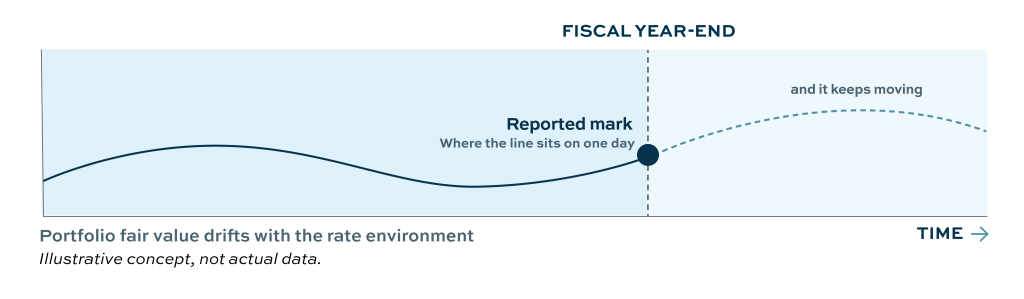
Under governmental accounting standards (principally GASB Statements 31 and 72), many investments are reported at fair value as of the fiscal-year-end date. Because prices move with interest rates, a portfolio of marketable securities will show unrealized gains or losses on the closeout date that reflect where rates happen to sit. Those marks are real for reporting, but they are unrealized: nothing has been sold, and the entity has neither gained nor lost until it chooses to act. A fair-value swing at year-end is a normal feature of a marked-to-market portfolio, not a flaw. A figure shaped by one day’s rate environment is a measurement, not a mandate.
How a Balance Is Held Changes the Picture
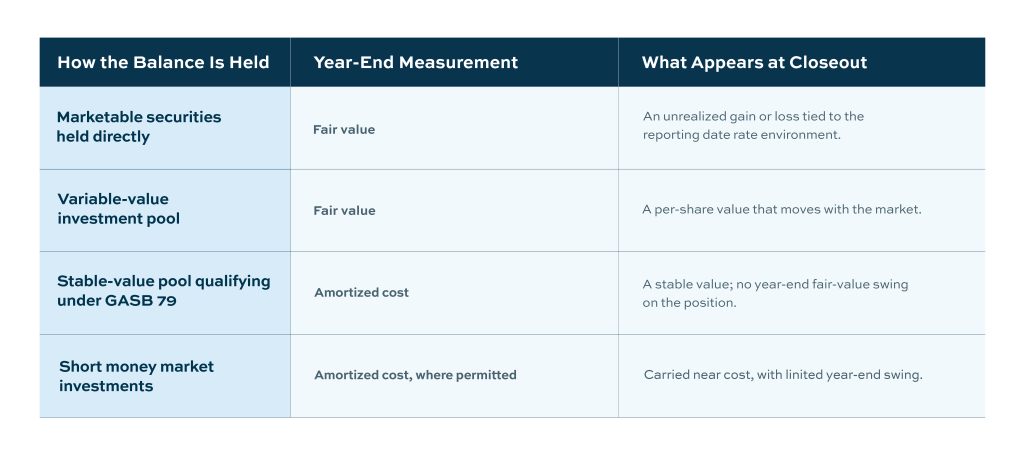
What appears on the statement also depends on the vehicle. A local government investment pool that qualifies for amortized-cost measurement under GASB Statement 79 transacts at a stable value, and its participants report their positions at amortized cost, so those balances show no year-end fair-value swing. The same dollars held directly in marketable securities, or in a variable-value pool, are marked to fair value and will show a year-end fair-value swing. Neither treatment is better than the other; they are different reporting methods for different structures.
Knowing in advance which balances will carry a year-end mark and which will not turns the reporting-date swing into something expected and planned for, rather than a surprise that prompts a reaction. The point is simply that two entities with identical economics can show very different year-end optics depending on how the money is held, which makes those optics a poor basis for an investment decision.
Two Temptations at the Line
When the reporting date drives the decision rather than the cash-flow calendar, it tends to show up as one of two temptations. The first is a pull toward cash: selling marketable holdings to present a larger cash position, or to avoid showing an unrealized loss. The second is the opposite, a pull toward yield: reaching for a higher year-end return, or realizing gains, to lift reported income. Both react to the snapshot rather than to need, and both can leave the entity worse off. Selling sound holdings to erase a paper mark can lock in a real loss and create reinvestment risk, while stretching for yield at the turn of the year can drain liquidity precisely when obligations come due.
Position for Cash Needs, Not the Date
The disciplined alternative starts from the entity’s real calendar, not the accounting one. Map the obligations that must be settled through the closeout and into the early weeks of the new year, and keep that liquidity in daily-access vehicles where it belongs. Recognize that balances carried forward or reappropriated keep the same purpose and horizon they had before the books closed; a change of fiscal year does not shorten the time until the money is needed. And treat a year-end mark on longer holdings for what it is, a snapshot, rather than a reason to trade. Where action is warranted, it should be for real reasons: funding known obligations, reinvesting maturities within policy, or rebalancing back to policy targets, not dressing the statement.
The Practical Takeaway
A fiscal-year closeout is one of the most visible moments in the public finance calendar, which is exactly why it invites reaction. But the statement it produces is a snapshot, shaped by the reporting date and by how each balance happens to be held, not by what the entity needs. The stronger approach is quieter. Match each balance to the right vehicle for its purpose, hold the liquidity the transition actually requires, and let the reporting date pass without churning the portfolio to meet it. Year-end is not the finish line. It is one marker in a cycle that continues, and the portfolio should be managed for the cycle rather than the marker.
About Deep Blue Investment Advisors
At Deep Blue Investment Advisors, we specialize in helping government finance officers expand their horizons by diving into fixed-income management solutions with tangible results. Our team of experienced investment management professionals can help tailor a portfolio to your investment needs while providing regular reporting, portfolio compliance, and performance meetings. You can always count on us to prioritize our relationships, provide guidance, and act in your best interest.
To speak with an advisor or for additional information about this article or Deep Blue Investment Advisors, please connect with one of our advisors today.
Deep Blue Investment Advisors is an investment advisor registered with the U.S. Securities and Exchange Commission. This communication is provided for informational purposes only and is not an offer to sell or a solicitation of an offer to buy any investments offered by Deep Blue Investment Advisors, nor shall any such investments be offered or sold to any person in any jurisdiction in which such an offer, solicitation, purchase or sale would be unlawful under the securities laws of such jurisdiction. Past performance is not an indicator of future results.
The information set forth herein is intended only for the person or entity to which it is addressed. By accepting this communication, you agree to maintain the confidentiality of its contents and agree not to distribute this communication to any other person or to use it other than for the purposes described above.