

For many public entities, the heaviest stretch of the year is defined not by the market but by the calendar of tax collections, and its realities are predictable ones. As property-tax dollars are collected and distributed through the late fall and winter, balances swell across the entities that hold and manage them, a large but temporary inflow of public money that then draws down over the year as it is spent. For the collectors who receive it first, the money may pass through in a matter of weeks; for the governments, districts, and authorities it ultimately funds, it is theirs to manage for far longer. Either way, it lands alongside the reconciliation, reporting, and the closing of the books already underway, and the records the season produces are the ones a later review will examine most closely.
None of that is a surprise, which is precisely the point. The season is less an event to react to than a set of known pressures to prepare for. The real question is how to manage the inflow well, and it comes down to two things: keeping the funds within policy, which includes putting the balances not needed right away to appropriate, policy-consistent use rather than leaving them idle, and keeping the team’s work orderly and defensible under the load. Managing public funds has always meant safety and liquidity first, then appropriate return, and a temporary surge does not change that order.
Those two demands, staying compliant and staying productive, run in parallel through the season. Figure 1 sets them side by side across its phases. Treated as competing priorities, they strain a team. Prepared for together, they reinforce each other.
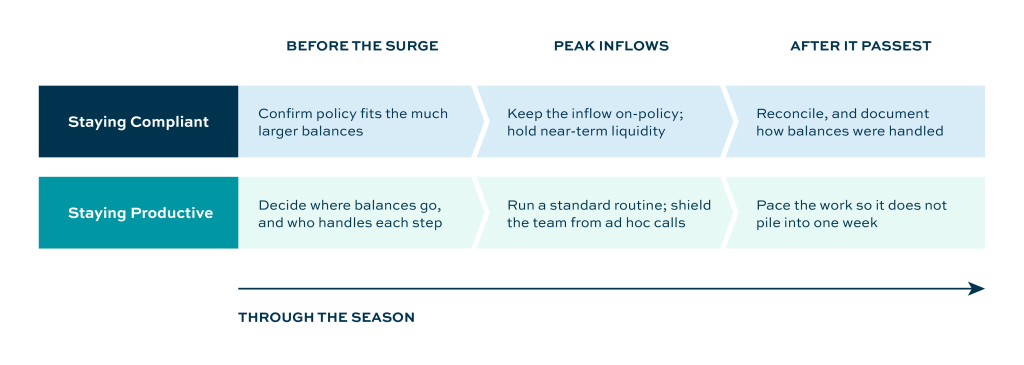

Staying Compliant as Balances Swell
A larger balance does not change the rules; it raises the stakes of following them. The policy questions that govern the portfolio in a quiet month apply with more weight when receipts are arriving in volume: whether there is enough liquidity for near-term obligations, whether the funds sit in permitted investments, whether the balance is diversified rather than concentrated, and whether everything is properly held and safeguarded. Much of a seasonal inflow is temporary, spent down over the year against real obligations, so the balances are best placed with that schedule in mind rather than left to sit unmanaged. Deciding where they go before they arrive keeps those questions from being answered under time pressure.
Reconciling as the money comes in, rather than after, and documenting clearly how the balances were handled keeps compliance from becoming a year-end scramble, and leaves clean records for the review that follows. The aim is to reach the close of the season on-policy and on-record, not to reconstruct the story afterward.
Staying Productive Under the Load
The workload of tax season is unusual in that it is almost entirely predictable. The timing, the volume, and the tasks can be estimated well in advance, which means the pressure can be planned for rather than simply absorbed. The teams that stay productive settle the routine before the busy weeks: how receipts are recorded and moved, where balances are placed, who handles each step, and when reconciliation happens, so the season runs on a standardized process rather than on a series of one-off decisions.
Decisions improvised under time pressure are where both errors and compliance slips tend to appear. Standardizing the routine handling of receipts, and shielding the team from having to improvise during the peak, helps protect accuracy and capacity at the same time. Sequencing the work so that reconciliation and reporting do not all fall in the same week keeps any single stretch from becoming the bottleneck for the whole season. Productivity here is less about working faster than about removing the decisions that do not need to be made in the moment.
Settle It Before the Surge
Most of what protects the season can be decided before it begins. The busy weeks are far easier when the destination of seasonal balances, the liquidity set aside for near-term obligations, and the handling of any restricted or earmarked funds are already settled, and when everyone knows who does what and how it will be documented. Figure 2 gathers the decisions worth making in advance, while there is still time to make them well.
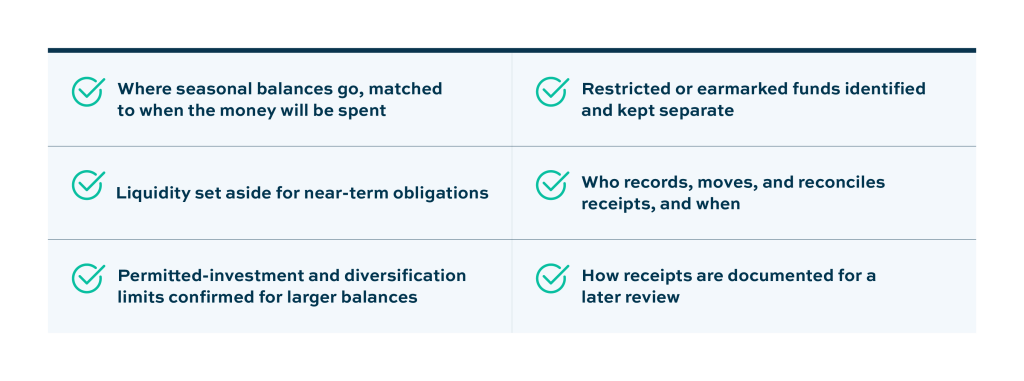
The Same Preparation Serves Both
Working through that list does two things at once, and this is the reassuring part of the season: compliance and productivity are not a trade-off. The preparation that keeps a program compliant, confirming destinations and limits in advance, standardizing the routine, and capturing records as the work is done, is the same preparation that keeps a team productive. Figure 3 shows the one feeding the other.
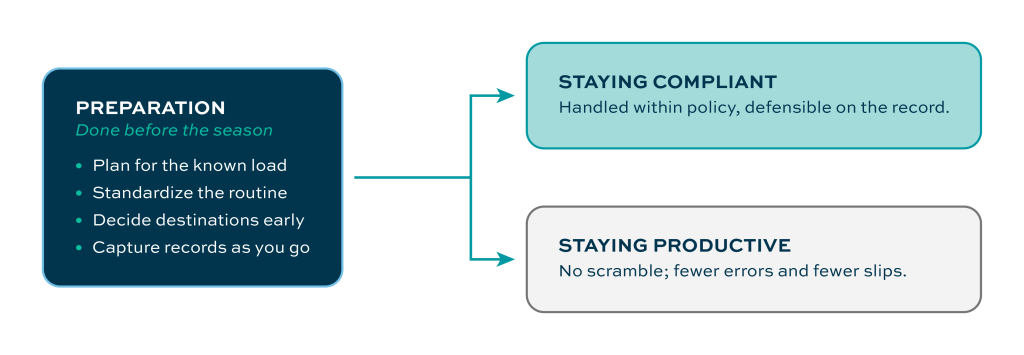
Seen that way, the season stops being a test of endurance and becomes a test of preparation. A documented, standardized process is at once the compliant path and the efficient one, and the work of building it belongs before the surge, not during it.
Ending the Season Well
Tax season will always bring more money and more work at the same time, and no plan removes the load entirely. But the entities that come through it well are rarely the ones that simply worked harder in the moment. They are the ones that treated a predictable season as something to prepare for: balances kept safe and liquid, put to appropriate use, and matched to real needs; records kept as the work was done; and a routine that held up under pressure. Managed that way, staying compliant and staying productive stop competing, and the season ends on-policy, on-record, and without the team worn thin.
About Deep Blue Investment Advisors
At Deep Blue Investment Advisors, we specialize in helping government finance officers expand their horizons by diving into fixed-income management solutions with tangible results. Our team of experienced investment management professionals can help tailor a portfolio to your investment needs while providing regular reporting, portfolio compliance, and performance meetings. You can always count on us to prioritize our relationships, provide guidance, and act in your best interest.
To speak with an advisor or for additional information about this article or Deep Blue Investment Advisors, please connect with one of our advisors today.
Deep Blue Investment Advisors is an investment advisor registered with the U.S. Securities and Exchange Commission. This communication is provided for informational purposes only and is not an offer to sell or a solicitation of an offer to buy any investments offered by Deep Blue Investment Advisors, nor shall any such investments be offered or sold to any person in any jurisdiction in which such an offer, solicitation, purchase or sale would be unlawful under the securities laws of such jurisdiction. Past performance is not an indicator of future results. This material is provided for informational and educational purposes only and does not constitute legal, tax, investment, or compliance advice; entities should consult their own advisors and applicable state law.
The information set forth herein is intended only for the person or entity to which it is addressed. By accepting this communication, you agree to maintain the confidentiality of its contents and agree not to distribute this communication to any other person or to use it other than for the purposes described above.