

Year-end volatility is not a forecast to get right. It is a position to be ready for, and readiness rests on three things a public portfolio can actually control: its liquidity, its discipline, and where it spends its attention.
The final weeks of the calendar year put public finance teams under a particular kind of pressure. Reporting and reconciliation cycles intensify, audit work is often already underway, and the market tends to feel unsettled at the same moment. Prices move, headlines multiply, and the Federal Reserve’s next step is rarely certain. Together, these factors create a strong pull toward doing something.
Yet the market and the Federal Reserve are not within any single entity’s control, and anticipating them is not where a public portfolio’s advantage lies. What a finance officer can control is how ready the portfolio is when conditions move. At year-end, readiness matters far more than prediction.
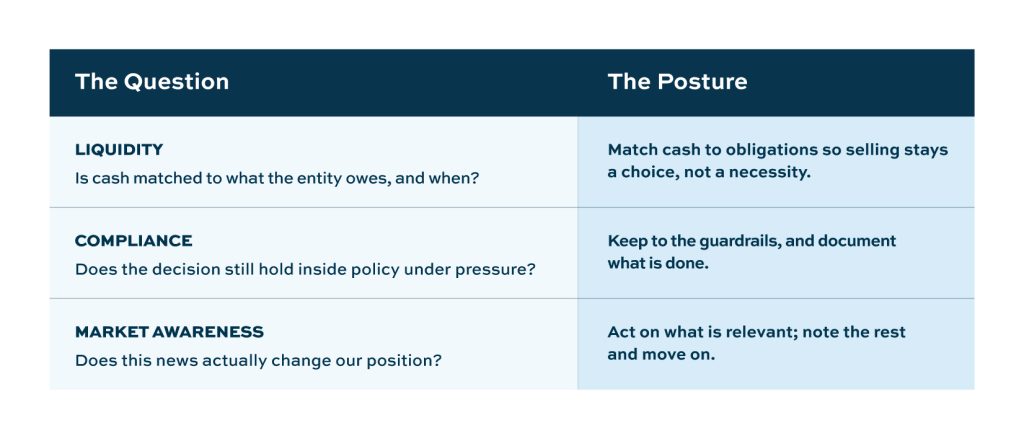
Readiness rests on three things this article will examine: liquidity that is matched to real obligations, compliance discipline that holds when it would be easy to bend, and market awareness that is spent on what is relevant rather than on what is loud. None of the three requires a forecast. Each is within the entity’s own hands.

Liquidity: Start With Obligations, Not the Market
Year-end concentrates obligations. Final payroll runs, vendor and contractor payments, debt-service dates, and early-January needs often fall within the same few weeks. The first question of the season is therefore not what the market is doing, but what the entity owes and when. A portfolio built around that answer is rarely troubled by a noisy market, because it does not need to sell into one to raise cash.
Long-standing practice for public funds is to map liquidity in layers, matched to when the money is actually needed. Operating balances cover near-term disbursements and stay in same-day vehicles. A near-term reserve covers the known and probable needs of the coming months, with maturities structured to their due dates. Core balances, not expected to be used soon, can look past a temporary rate move or a year-end mark without reacting. Figure 2 sets out the layers along the horizon they serve.
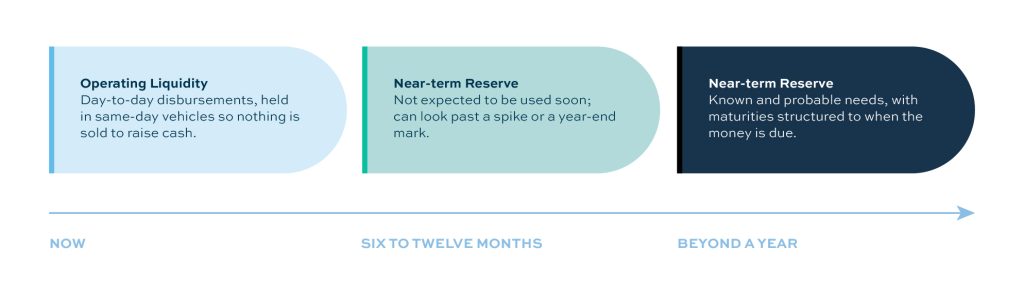
The practical work at year-end is to fund the known obligations before the turn, keep the operating buffer genuinely liquid, and avoid a wall of maturities that all come due in the busiest weeks. When cash is already positioned against real needs, a choppy December becomes something to observe rather than to trade around. Liquidity is the first anchor because it removes the pressure to act at exactly the wrong time.
Compliance: The Discipline That Holds Under Pressure
Year-end is when the temptation to make an exception is highest, and it arrives at the busiest moment. A briefly attractive rate, a crowded closeout calendar, and a general sense of urgency can combine to push a decision that would not be made in a calmer month. It also tends to land when reporting and oversight cycles are already demanding, so a decision made under pressure is one that may later need to be explained.
This is precisely when an investment policy earns its keep. The authorized-investment list, the maturity limits, and the diversification and liquidity requirements are not obstacles to work around under pressure. They are the guardrails built for exactly these conditions. In public finance, state law puts safety and liquidity ahead of return and calls for regular reporting to the governing body, and the discipline those rules encode is most valuable in the moments it is most tempting to set aside.
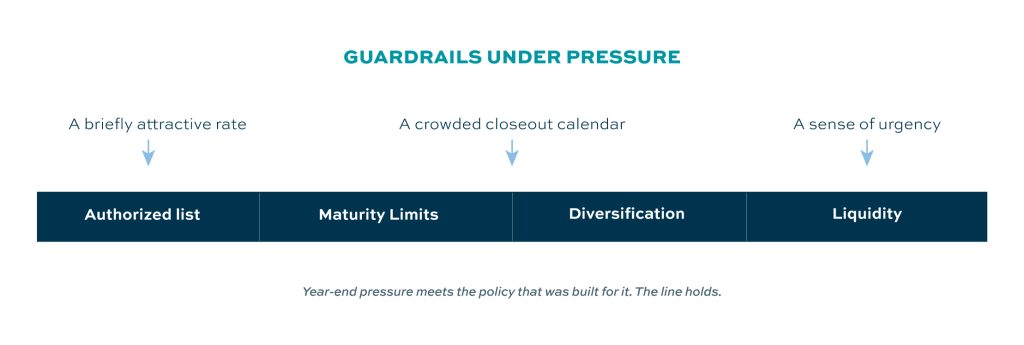
Holding to policy through a noisy quarter is therefore two things at once: an investment discipline and a compliance one. Decisions made under pressure should be made within the policy and documented as they are taken, so that what looked prudent in the moment also holds up when it is later reviewed. Staying on-policy and on-record is the posture that carries an entity cleanly through the close.
Market Awareness: Spend Attention on What Is Relevant
Awareness is not the same as reaction. The goal at year-end is not to predict the Federal Reserve or to call the market’s next move. It is to judge what deserves a response and what does not, and to spend a scarce resource, attention, on the things that actually bear on the entity’s position.
A simple test does most of the work. Does the news change the entity’s obligations, its liquidity needs, or its policy constraints? If it does, it warrants a review, and any action taken belongs within policy. If it does not, it is information rather than instruction: worth noting, not worth trading on. A great deal of what fills a year-end news cycle does not pass that test. Figure 4 puts the filter in one view.
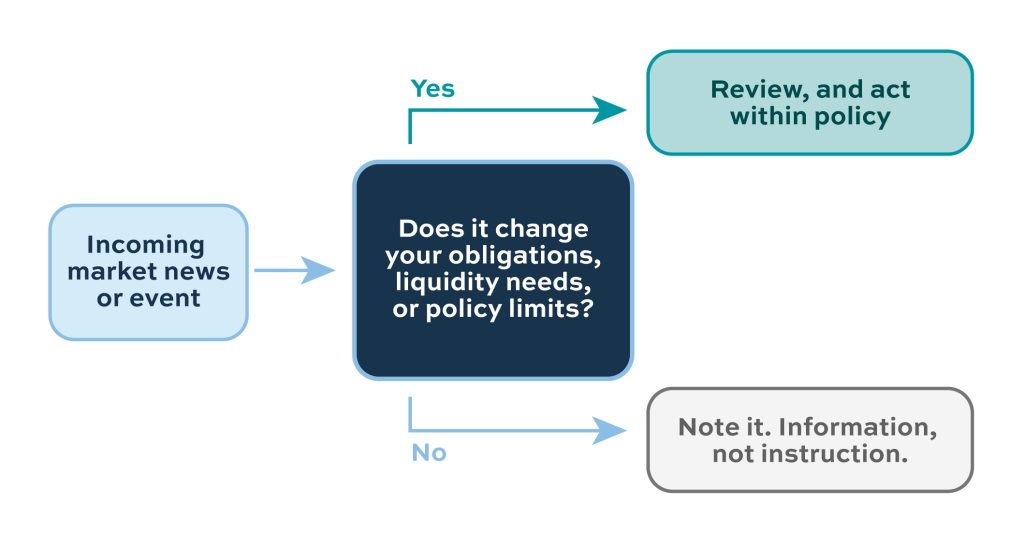
Federal Reserve uncertainty is the clearest case. Because the next move cannot be known in advance, the sound response is not to guess it but to be positioned so the portfolio does not depend on guessing right. Awareness spent this way is steady rather than anxious, and it keeps attention where it belongs, on the entity’s own obligations rather than on the market’s mood.
Composed Through the Turn
Year-end will feel turbulent, because the market’s movement and the operational workload arrive together. But feeling turbulent and requiring action are not the same thing. The entities that come through the season best are not the ones that react fastest. They are the ones whose liquidity was already matched to their obligations, whose discipline held when it would have been easy to bend, and whose attention stayed on what was relevant.
Those three anchors do not shift with the calendar, which is what makes them dependable. Set in advance and held through the turn, they let a public portfolio meet year-end as a season to manage rather than an event to survive.
About Deep Blue Investment Advisors
At Deep Blue Investment Advisors, we specialize in helping government finance officers expand their horizons by diving into fixed-income management solutions with tangible results. Our team of experienced investment management professionals can help tailor a portfolio to your investment needs while providing regular reporting, portfolio compliance, and performance meetings. You can always count on us to prioritize our relationships, provide guidance, and act in your best interest.
To speak with an advisor or for additional information about this article or Deep Blue Investment Advisors, please connect with one of our advisors today.
Deep Blue Investment Advisors is an investment advisor registered with the U.S. Securities and Exchange Commission. This communication is provided for informational purposes only and is not an offer to sell or a solicitation of an offer to buy any investments offered by Deep Blue Investment Advisors, nor shall any such investments be offered or sold to any person in any jurisdiction in which such an offer, solicitation, purchase or sale would be unlawful under the securities laws of such jurisdiction. Past performance is not an indicator of future results. This material is provided for informational and educational purposes only and does not constitute legal, investment, or compliance advice; entities should consult their own advisors and applicable state law.
The information set forth herein is intended only for the person or entity to which it is addressed. By accepting this communication, you agree to maintain the confidentiality of its contents and agree not to distribute this communication to any other person or to use it other than for the purposes described above.