

For many public entities, the investment policy comes up for review on a set cycle, often as a new fiscal year approaches and the budget is adopted. Sometimes that review is simply good practice. Often it is required. Texas entities, for example, must review their investment policy and investment strategies at least annually and formally record that the review took place, and leading guidance from the Government Finance Officers Association recommends the same discipline more broadly.
A review, though, is a narrower exercise than it first appears. Opening the policy, the natural instinct is to find something to improve. The more useful instinct is to ask a smaller question: does the policy still reflect the entity’s objectives, its cash-flow reality, and current law? When the answer is yes, the right outcome may simply be to reaffirm it.
That distinction is where discipline shows. A policy earns much of its value from stability. Changed for the right reasons, it stays credible and clear. Changed for the wrong ones, it becomes another moving part in a program meant to provide steadiness.
A Review Cycle Is Healthy, and Often Required
Periodic review is a feature of sound public-funds management, not a sign that something is wrong. It gives the governing body a scheduled moment to confirm that the policy still fits the entity and still complies with the law. In Florida and Texas alike, state law puts safety and liquidity ahead of return, and calls for regular reporting and continuing education for the officials responsible for the funds. The specifics differ from state to state, but the principle is shared: the policy is meant to be revisited on a schedule, deliberately, rather than reacted to in the moment.
Reviewing a Policy Is Not the Same as Rewriting It
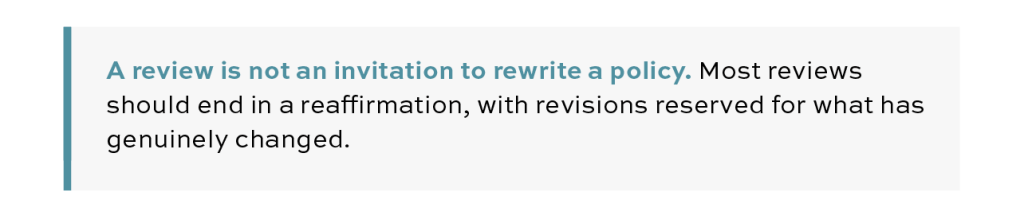
Because a review is scheduled, it can create a quiet pressure to produce a change, as though a review without edits is somehow incomplete. The opposite is closer to the truth. An investment policy works precisely because it does not move with every cycle. It sets the boundaries within which day-to-day decisions are made, and those boundaries are most useful when they are stable and well understood. A policy that is amended frequently, or in response to short-term conditions, gradually loses the authority that makes it worth having. For most entities in most years, the disciplined outcome of a review is confirmation, with refinements reserved for the margins. Recording that the policy was reviewed and deliberately left unchanged is a complete and defensible outcome, not a gap.
What Genuinely Warrants a Change
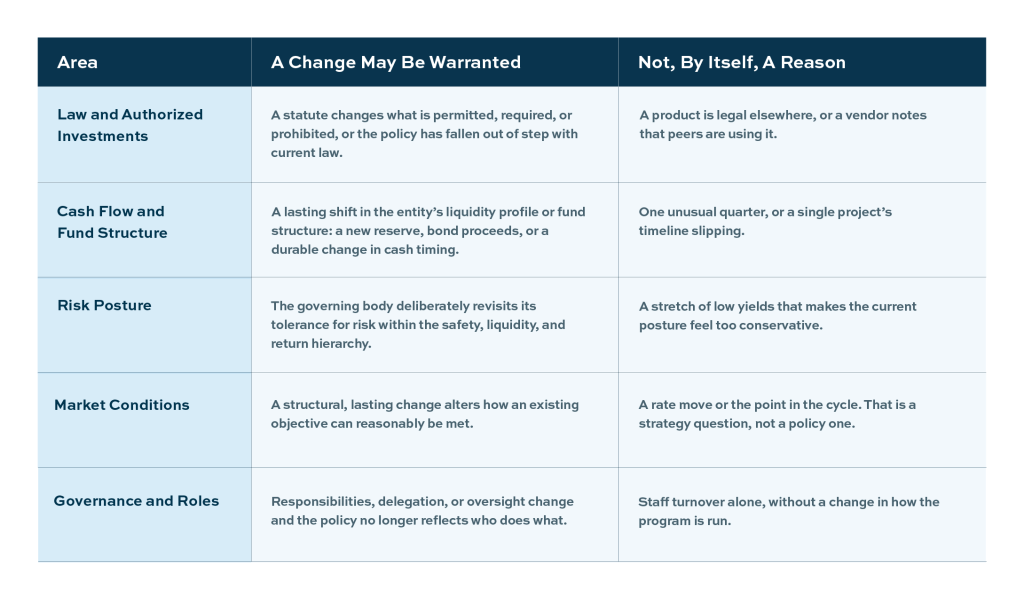
Some changes are not only appropriate but overdue, and a review is exactly when they should surface. What they share is a single test: something real and lasting has changed, not simply the mood of the market. The practical way to apply that test is to trace the cause and ask whether it is temporary or permanent. Several months of elevated operating cash that can be traced to a one-time grant, to be spent by spring, argue for leaving the policy alone; the same balances arising from a permanent new revenue stream are a genuine shift in the entity’s cash profile, and the policy that governs it may need to catch up. What matters is the line between change that reflects the entity’s circumstances and change that merely chases them. The table below sorts the genuine reasons from the pressures that only resemble them.
Policy Governs, Strategy Flexes
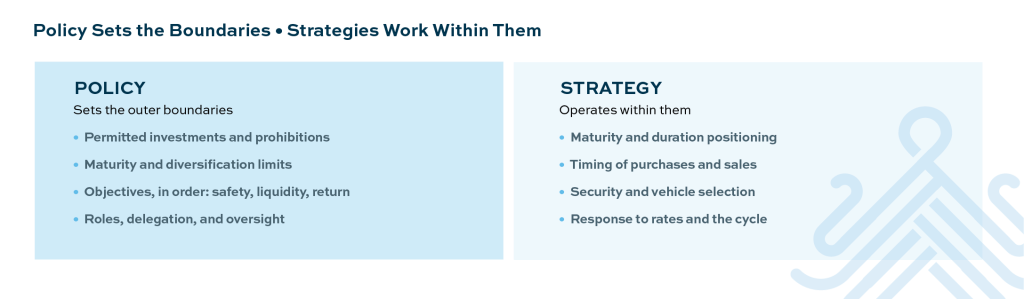
Many of the pressures that arrive disguised as policy questions are really strategy questions. A move in rates, a stretch of disappointing yields, a product a peer has adopted, or the particular point in the market cycle can all make a stable policy feel too restrictive. In most cases, the right response is not to change the policy but to use the flexibility the policy already allows. Policy sets the outer boundaries; strategy operates within them. Keeping that line clear protects the policy from being rewritten every time conditions shift, and it keeps the governing body focused on the decisions that genuinely belong to it.
Running the Review Well
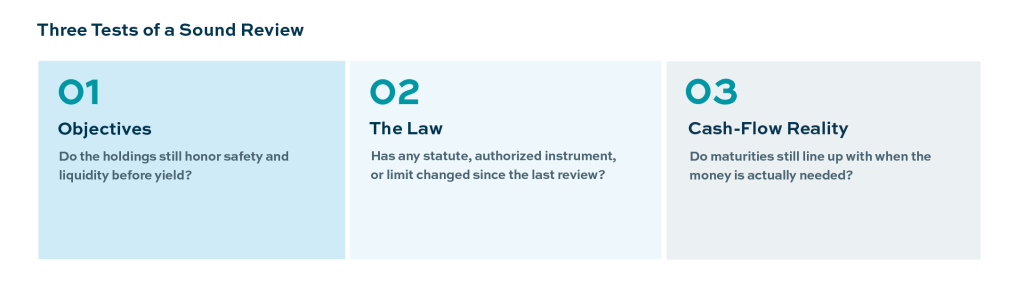
A sound review comes down to three tests, set out below, and then to how the review is run. Beyond the tests, the discipline is in the conduct. It separates the review of the policy from the review of strategy, so that short-term performance does not drive long-term boundaries. It documents the outcome, which in some states is not optional. And it resists the urge to treat every review as an occasion for change. The most valuable review is often the one that ends with a governing body confirming, on the record, that the policy still serves the entity well.
The Practical Takeaway
An investment policy is not meant to keep pace with the market. It is meant to give a public entity a stable, defensible framework that holds up across cycles. The goal of a review, then, is not a policy that changes often, but one durable enough that it rarely needs to. Review it on schedule, document the review, and change it when something real has changed. The discipline to hold the line the rest of the time is not inaction. It is stewardship.
About Deep Blue Investment Advisors
At Deep Blue Investment Advisors, we specialize in helping government finance officers expand their horizons by diving into fixed-income management solutions with tangible results. Our team of experienced investment management professionals can help tailor a portfolio to your investment needs while providing regular reporting, portfolio compliance, and performance meetings. You can always count on us to prioritize our relationships, provide guidance, and act in your best interest.
To speak with an advisor or for additional information about this article or Deep Blue Investment Advisors, please connect with one of our advisors today.
Deep Blue Investment Advisors is an investment advisor registered with the U.S. Securities and Exchange Commission. This communication is provided for informational purposes only and is not an offer to sell or a solicitation of an offer to buy any investments offered by Deep Blue Investment Advisors, nor shall any such investments be offered or sold to any person in any jurisdiction in which such an offer, solicitation, purchase or sale would be unlawful under the securities laws of such jurisdiction. Past performance is not an indicator of future results.
The information set forth herein is intended only for the person or entity to which it is addressed. By accepting this communication, you agree to maintain the confidentiality of its contents and agree not to distribute this communication to any other person or to use it other than for the purposes described above.